

Unlocking Investment, Empowering Employment
F4J Financial Instruments
The F4J Financial Instruments are innovative financing mechanisms designed to stimulate private sector investment, create sustainable employment opportunities, mobilize private capital, and support youth-focused initiatives through results-based financing and blended finance models.


Who we are
Finance For Jobs (F4J) series of projects: Investment in the Economy and Human Capital
F4J project has been implemented in three successive phases, each building on the achievements and lessons learned from the previous one. F4J 1 focused on designing and piloting innovative financial instruments aimed at addressing market constraints, stimulating private sector investment, and creating employment opportunities. This phase served as a proof of concept to identify effective approaches and refine implementation modalities. Building on these foundations, F4J 2 shifted from piloting to scaling, expanding successful interventions to reach a broader base of private sector beneficiaries and increase investment mobilization and job creation. F4J 3 continues this trajectory by further deepening private sector engagement and promoting inclusive, sustainable job creation, with a focus on strengthening economic growth and resilience.
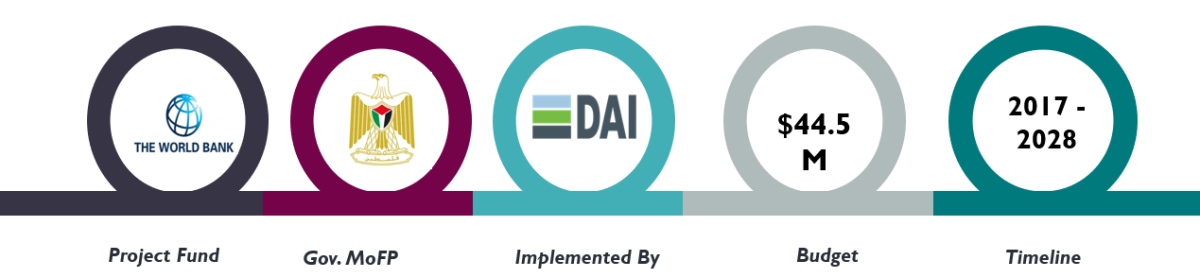
Finance for Jobs is a series of projects over 8 years with a budget of $44.5 million, for the benefit of the Ministry of Finance and Planning (MoFP), funded by the World Bank and implemented by DAI. The project is a public finance mechanism aiming to bolster the Palestinian economy by incentivizing private capital mobilization and job creation in the West Bank and Gaza.
F4J’s Objectives:
- Stimulate private capital mobilization by fostering private sector investments.
- Job creation opportunities in the West Bank and Gaza.
F4J’s Financing Instruments:
The project adopts two innovative financing instruments to encourage new investments and qualify youth graduates to enter the labor market: Investment Co-Financing Facility (ICF) and Development Impact Bond (DIB).